
"Figure It Out Yourselves"
How MDE Abandoned Those Seeking Help, Then Helped Prosecute Them


While the Minnesota Department of Education (MDE) has positioned itself as a vigilant overseer that raised early fraud concerns in the Feeding Our Future case, recently uncovered emails tell a very different story. They reveal a pattern of regulatory abdication that directly contradicts MDE's narrative and raises serious questions about the department's credibility. This is on top of MDE's already well-documented credibility problems.
The Philosophy of Abdication
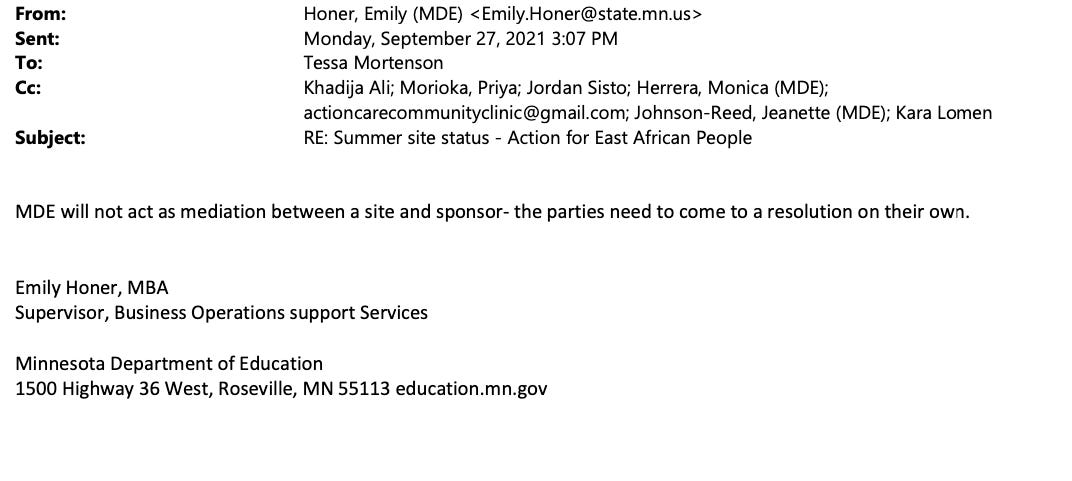
"MDE will not act as mediation between a site and sponsor- the parties need to come to a resolution on their own." - Emily Honer, September 27, 2021
This stark statement from Emily Honer, MDE's Supervisor of Business Operations Support Services, perfectly encapsulates MDE's approach to oversight: hands-off to the point of negligence. But it gets worse.
The Portland Avenue Problem
Take the case of Action for East African People's (AFEAP) summer food site. According to Honer's email from September 27, 2021:
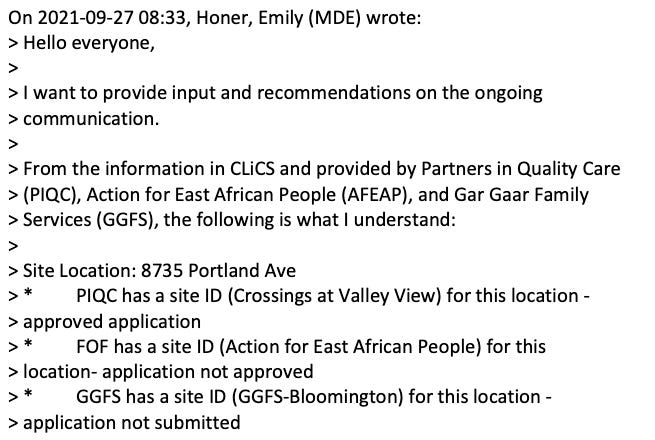
Site Location: 8735 Portland Ave
PIQC had an approved application for the site
FOF had an unapproved application for the same site
GGFS hadn't even submitted their application
Three different organizations claim the same site—a recipe for potential issues if I've ever seen one. MDE's response?
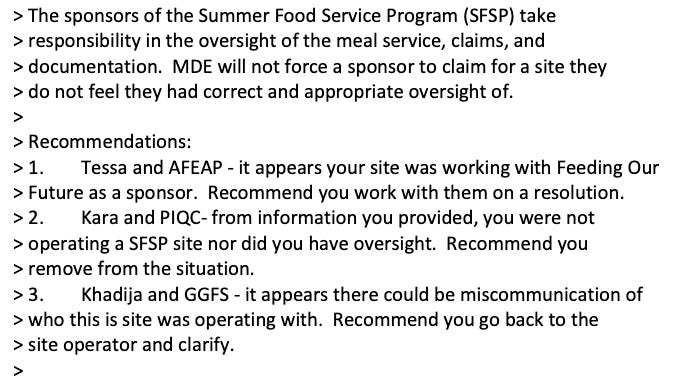
Essentially just telling everyone to work it out amongst themselves:
Tessa and AFEAP - work with Feeding Our Future
Kara and PIQC - remove from the situation
Khadija and GGFS - go back to the site operator and clarify
The Youth Leadership Academy Whiplash
This wasn't an isolated incident. The pattern of abdication becomes even more damning when we look at the Youth Leadership Academy case from earlier that summer. Here's where MDE's regulatory chaos shines through.
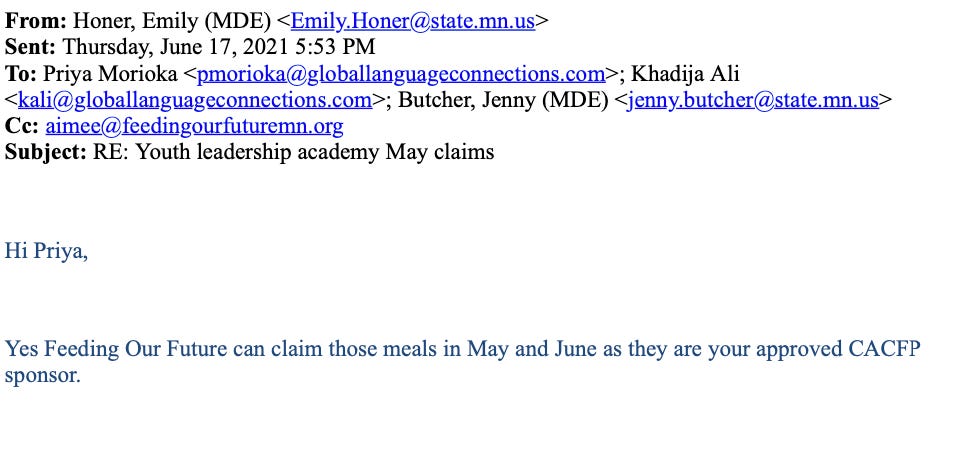
June 17, 2021:
"Yes Feeding Our Future can claim those meals in May and June as they are your approved CACFP sponsor." - Emily Honer
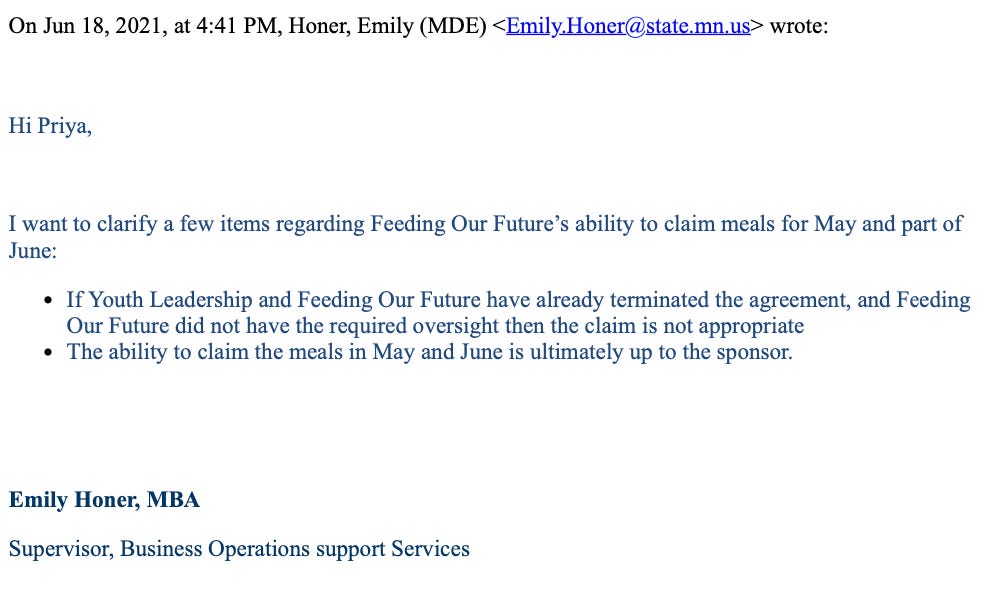
24 hours later:
"If Youth Leadership and Feeding Our Future have already terminated the agreement, and Feeding Our Future did not have the required oversight then the claim is not appropriate" - Emily Honer
The whiplash is impressive, isn't it? But more importantly, look at what this inconsistency does - it creates regulatory confusion that enables problems.

From the perspective of Feeding Our Future, MDE is putting them in a position to violate the law.
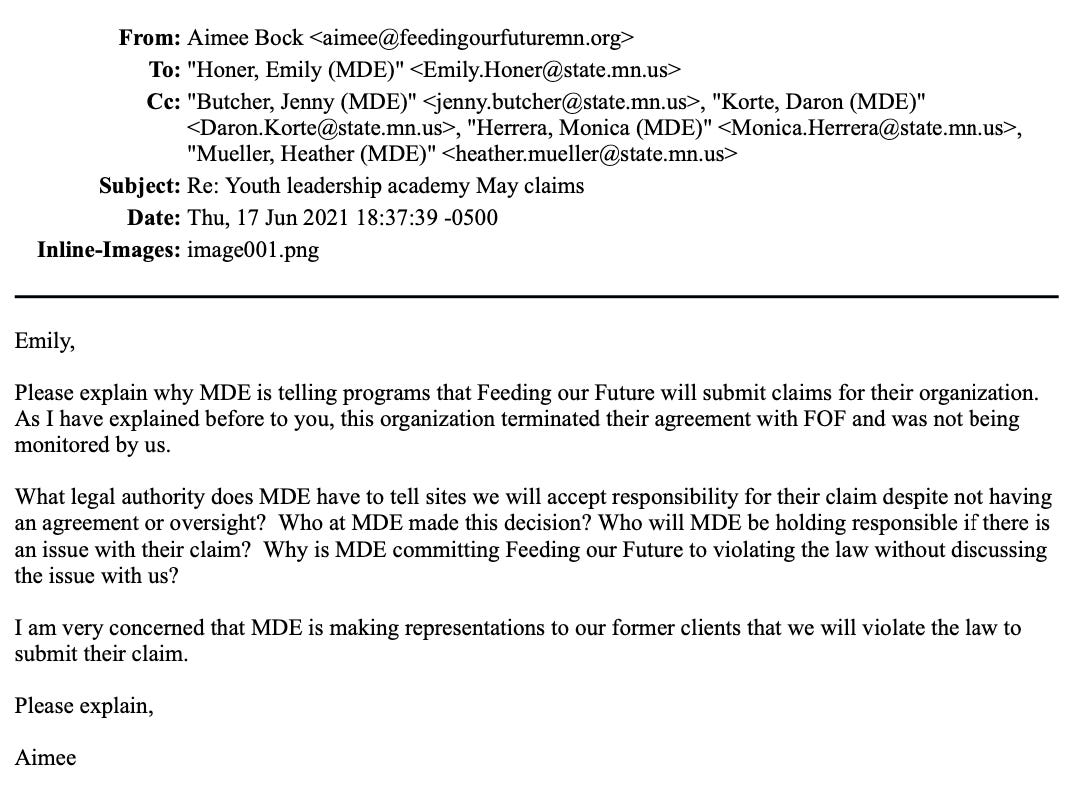
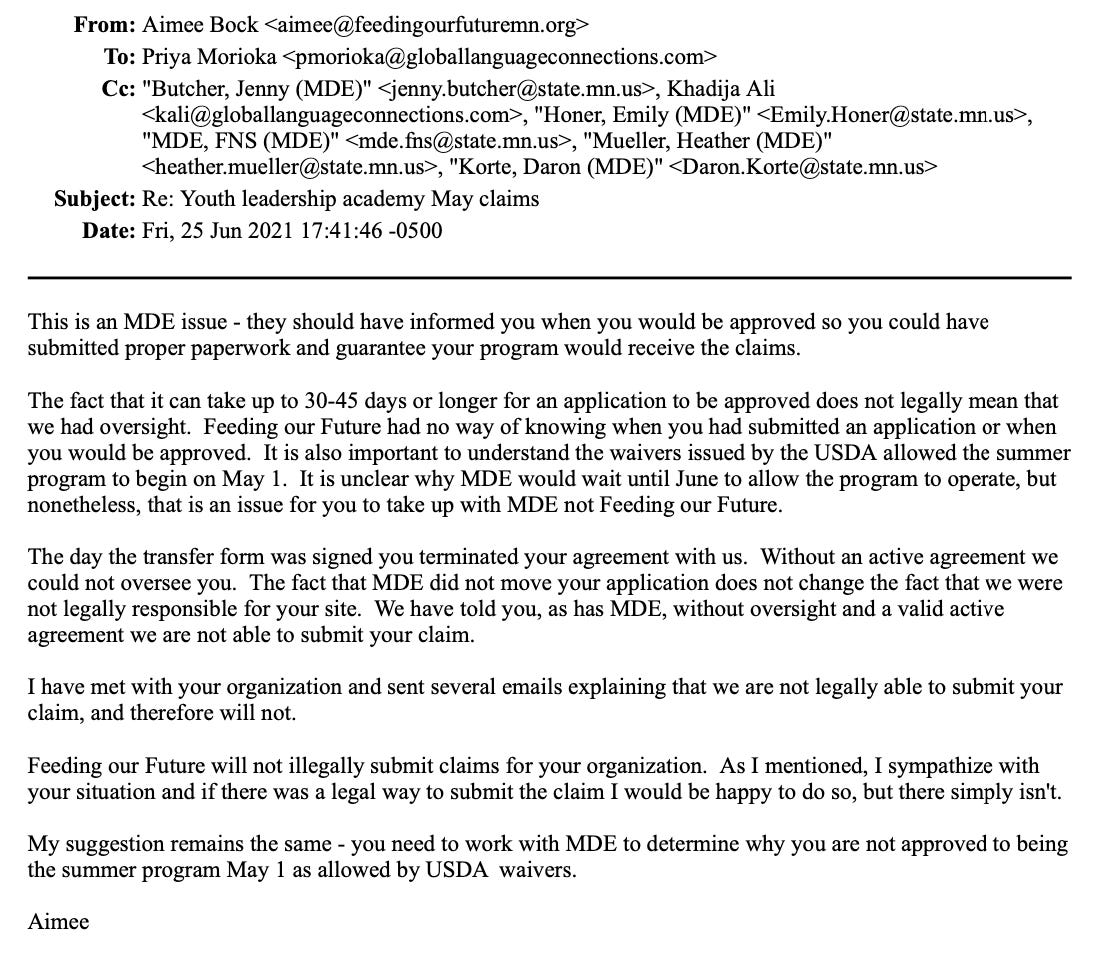
The Desperate Search for Guidance
The confusion this created wasn't minor. Sponsors and Sites repeatedly tried to get clear guidance:
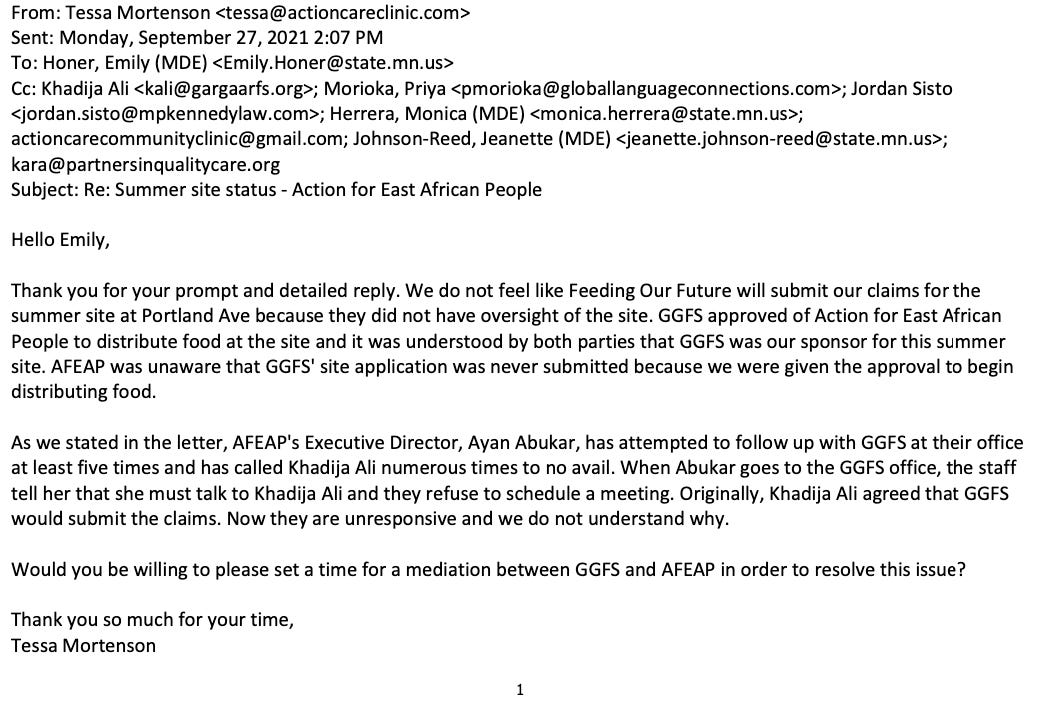
"Would you be willing to please set a time for a mediation between GGFS and AFEAP in order to resolve this issue?" - Tessa Mortenson
MDE's response? See where we started: "MDE will not act as mediation..."
The Paper Trail Problem
These emails are particularly damaging to MDE's credibility because they expose MDE’s contemporaneous knowledge of what was happening at the time. Still, MDE was unwilling to step in and provide support. This isn’t an isolated incident but a pattern. Look at the AFEAP situation:
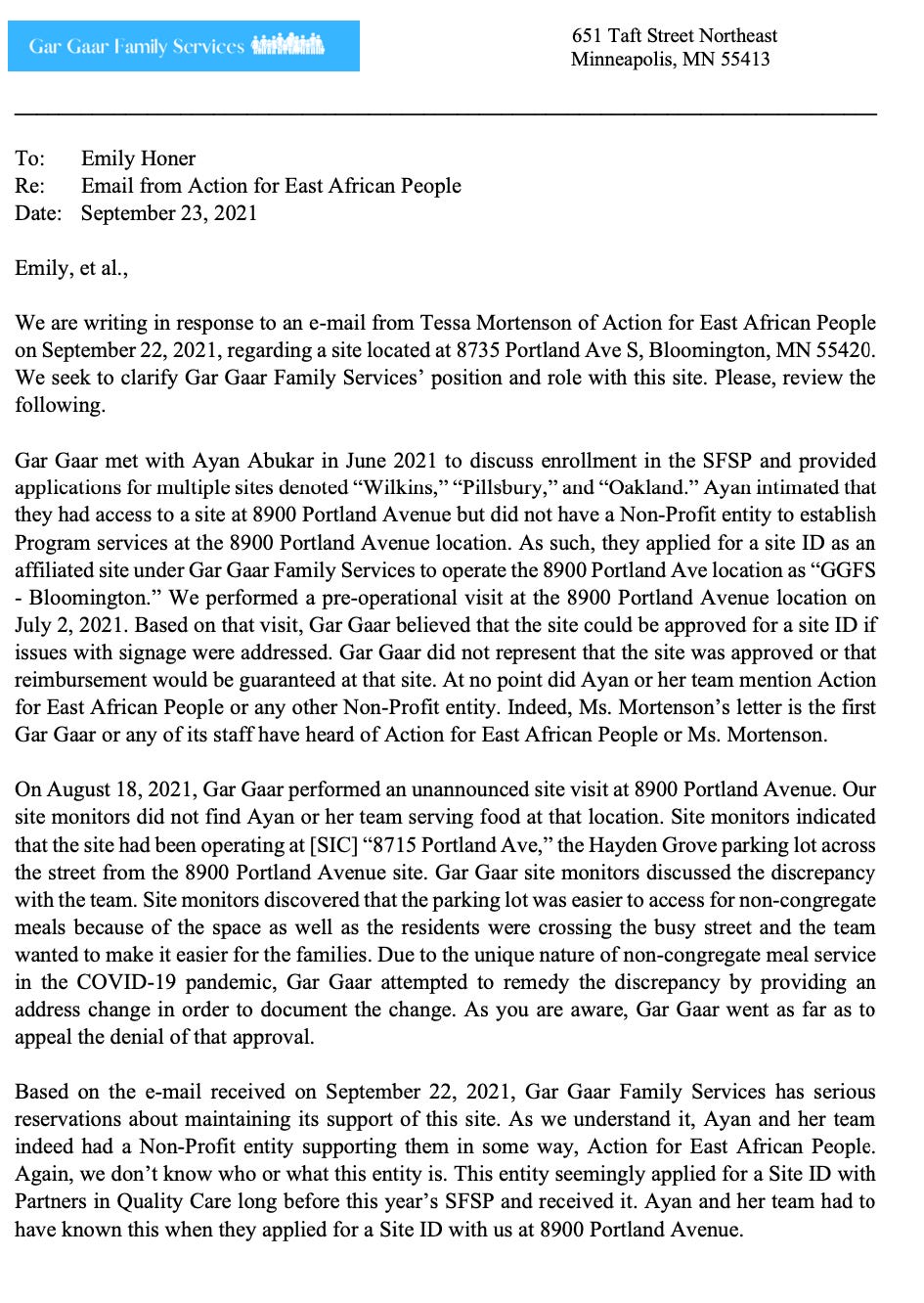
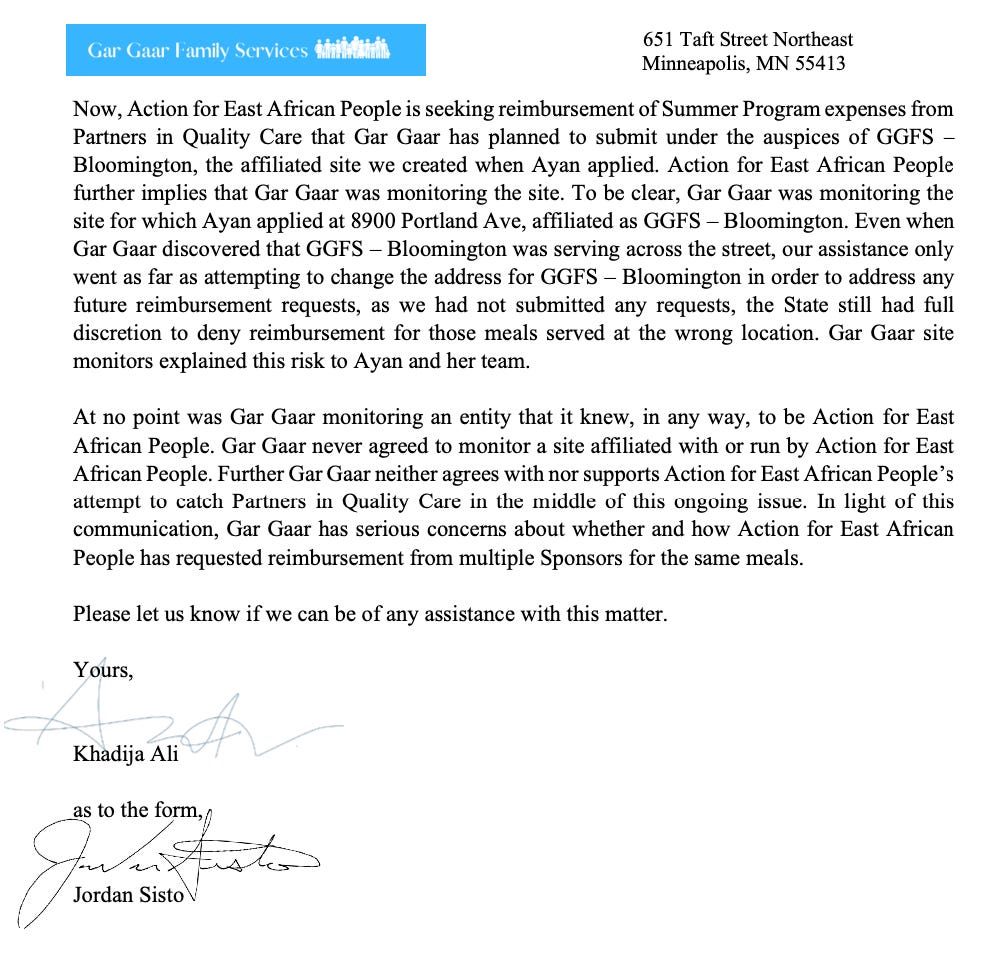
GGFS documented their site visits and monitoring efforts. But when questions arose about overlapping claims:
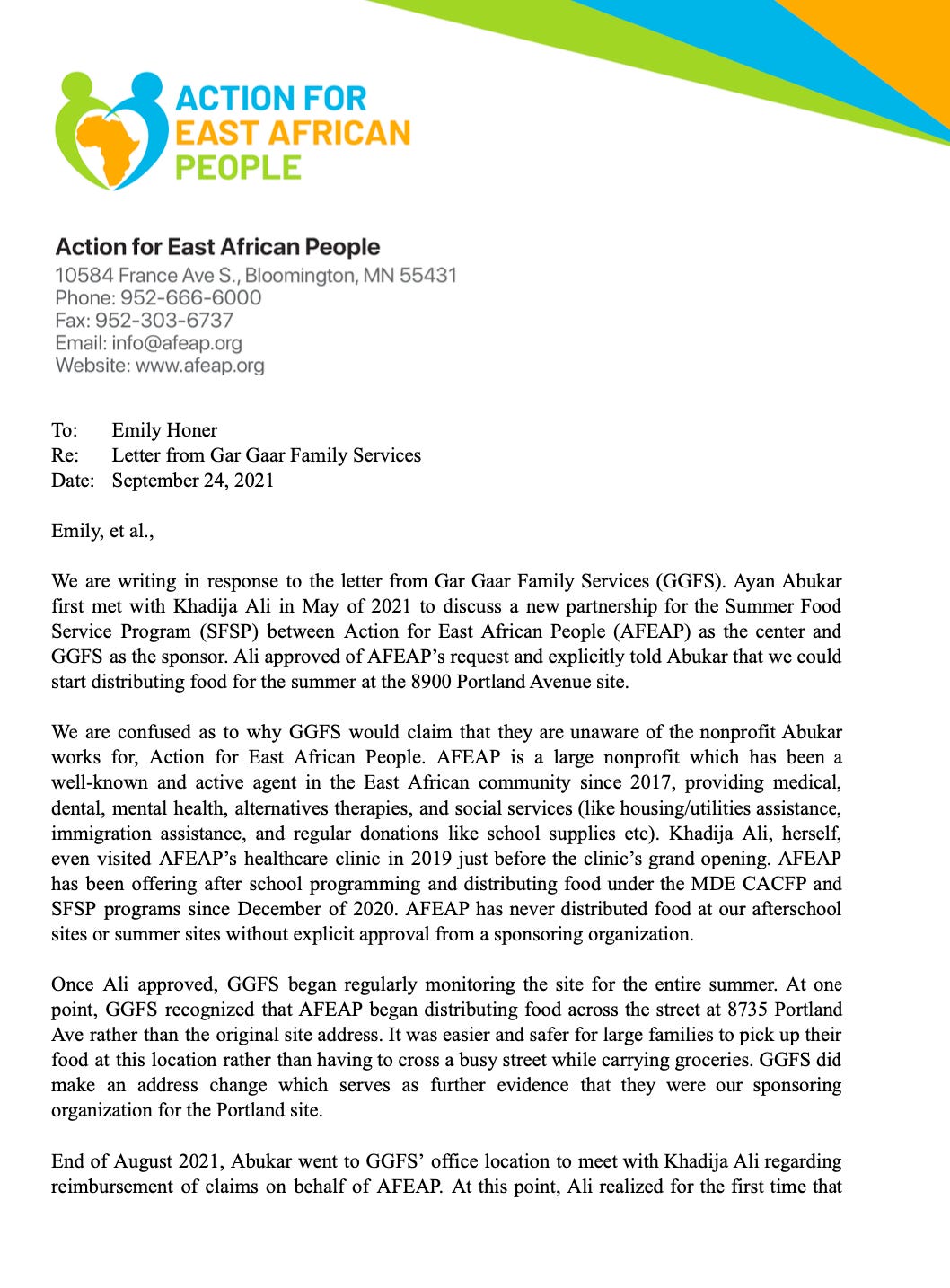
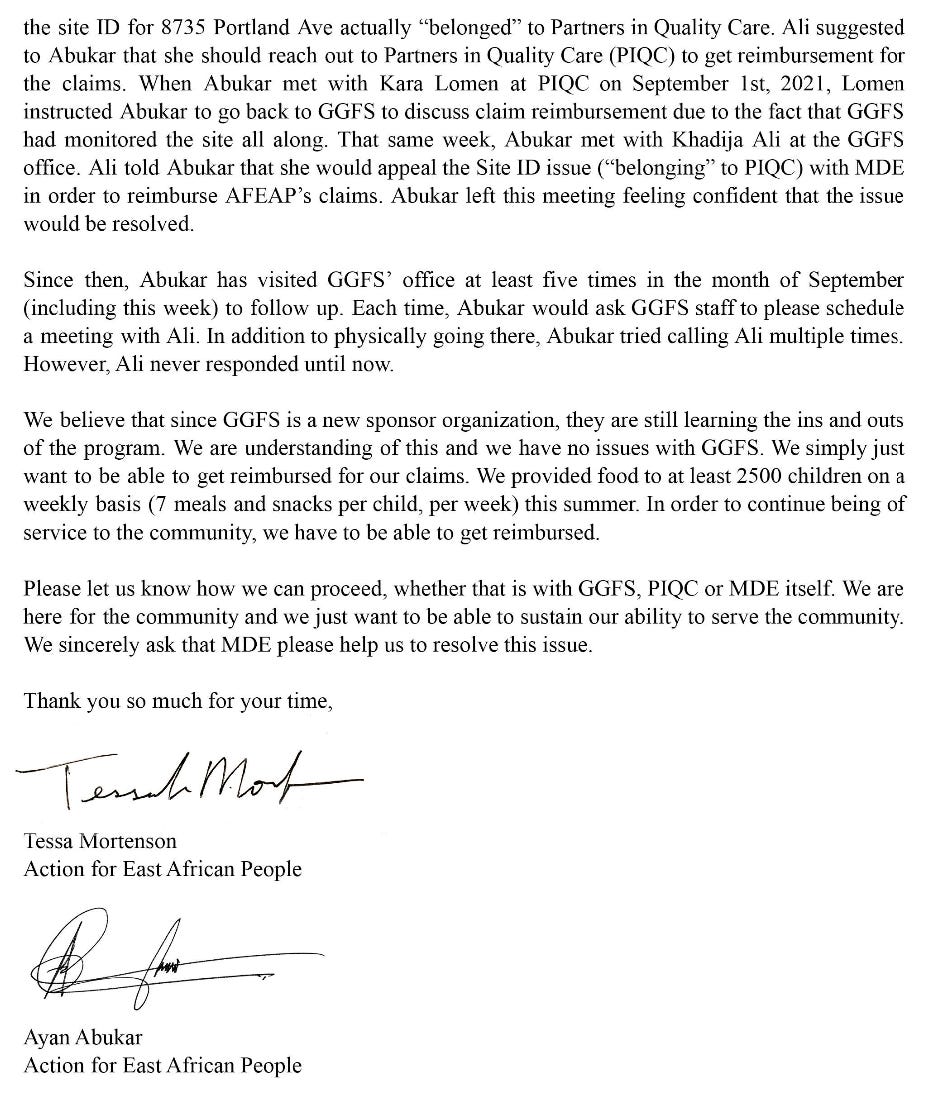
When questions arose about overlapping claims, sites provided detailed documentation of their operations and explicitly asked for guidance. MDE’s answer? Tough luck.
The Implications
This pattern of non-intervention raises serious questions:
1. If Honer et al. honestly had fraud concerns, why did she consistently choose not to investigate situations that practically screamed for oversight?
2. How can MDE claim to be a vigilant overseer while actively refusing to mediate disputes between sponsors and sites?
3. How can anyone seriously take fraud allegations from an agency that repeatedly abandoned its regulatory responsibilities?
The Timeline Tells All
Let's look at MDE's documented abdication:
June 17, 2021: Tells Youth Leadership Academy that FOF can submit claims
June 18, 2021: Reverses position completely
September 27, 2021: Refuses to mediate clear regulatory conflicts
Throughout Summer 2021: Ignores overlapping site applications
Each instance represents a missed opportunity and a conscious choice to avoid regulatory responsibility - choices that a truly vigilant oversight agency would never make.
The implications are clear. Either:
MDE was catastrophically incompetent at its oversight duties, or
The department's current narrative about early fraud concerns is, to put it politely, revisionist history
Neither option inspires confidence in the foundation of this prosecution.
MDE can't claim ignorance - they were in the email chains
MDE can't claim inability - they had regulatory authority
MDE can't claim proper oversight - they actively avoided it
MDE can't claim sponsors weren't doing their jobs - the documentation shows otherwise
When The System Fails Those Seeking Help
The most troubling aspect of this story isn't just MDE's failures - it's the human cost of their abdication. Consider this reality:
Organizations desperately reached out for guidance:
"Please provide a status update..."
"We would like to resolve this..."
"Can you please help mediate..."
"We need clarity on requirements..."
These weren't the actions of people trying to commit fraud. These were organizations actively seeking help from their regulatory agency - help they were entitled to, help they needed, help that never came.
Now, these same organizations face criminal charges for actions they tried to get guidance on. Let that sink in:
They asked for help, and MDE said, "Figure it out yourselves."
They sought mediation - MDE refused
They requested clarification - MDE gave contradictory answers
They documented their concerns - MDE took "no position."
How is this justice? How is this due process? How can we criminally charge people for actions they actively tried to prevent through proper channels?
This isn't just a story about regulatory failure. It's about a system that sets people up to fail and then criminalizes that failure. It's about an agency that abdicated its responsibility to help and then pointed fingers at those who begged for that help.
These emails undermine MDE's credibility and raise fundamental questions about the fairness of these prosecutions. Who bears the responsibility when the system fails those who seek its guidance?
Perhaps it's time to ask: Who's at fault when the watchdog refuses to watch, the guide refuses to guide, and the overseer refuses to oversee?
---